Gifts for amateur astronomers who do astrophotography with a DSLR under $100
The person who drives forty minutes from city lights and spends three hours in a damp field to photograph a galaxy two million light-years away will not be impressed by a star map poster. These are the tools that actually extend their sessions, sharpen their alignment, and keep the dew off the glass.
Item 1
An intervalometer is the first thing a DSLR astrophotographer actually needs and the last thing they think to ask for. This one programs the interval, exposure count, and bulb duration so they can step away from the camera entirely — no more blurry star trails from a shaky finger on the shutter button. Under $20 and it fixes a real problem immediately.
“The one reliable rule of gift-giving: anything that makes them look more serious at what they love will be received with disproportionate gratitude.”
Item 2
Earth rotates, and without a tracker, any exposure longer than about 20 seconds turns stars into streaks. This compact mount sits under a DSLR and compensates for that rotation, opening up two- and three-minute exposures on a wide-angle lens. Runs on AA batteries, fits in a jacket pocket, and represents the single largest image-quality jump available at this price.
Item 3
Dew doesn't announce itself — it just ruins the last hour of a session quietly and invisibly until you check the images at home. This heater strap wraps around the lens, runs warm enough to keep condensation off, and adjustable enough to fit most fast primes and kit lenses. The kind of accessory that earns its place on every future outing.
Item 4
A four-hour session eats camera batteries faster than any daylight shoot. This 20,100mAh bank recharges the DSLR and simultaneously powers the dew heater or star tracker — two USB ports, fast charging, and enough capacity to outlast even the most stubborn clear night. Not glamorous. Genuinely indispensable.
Item 5
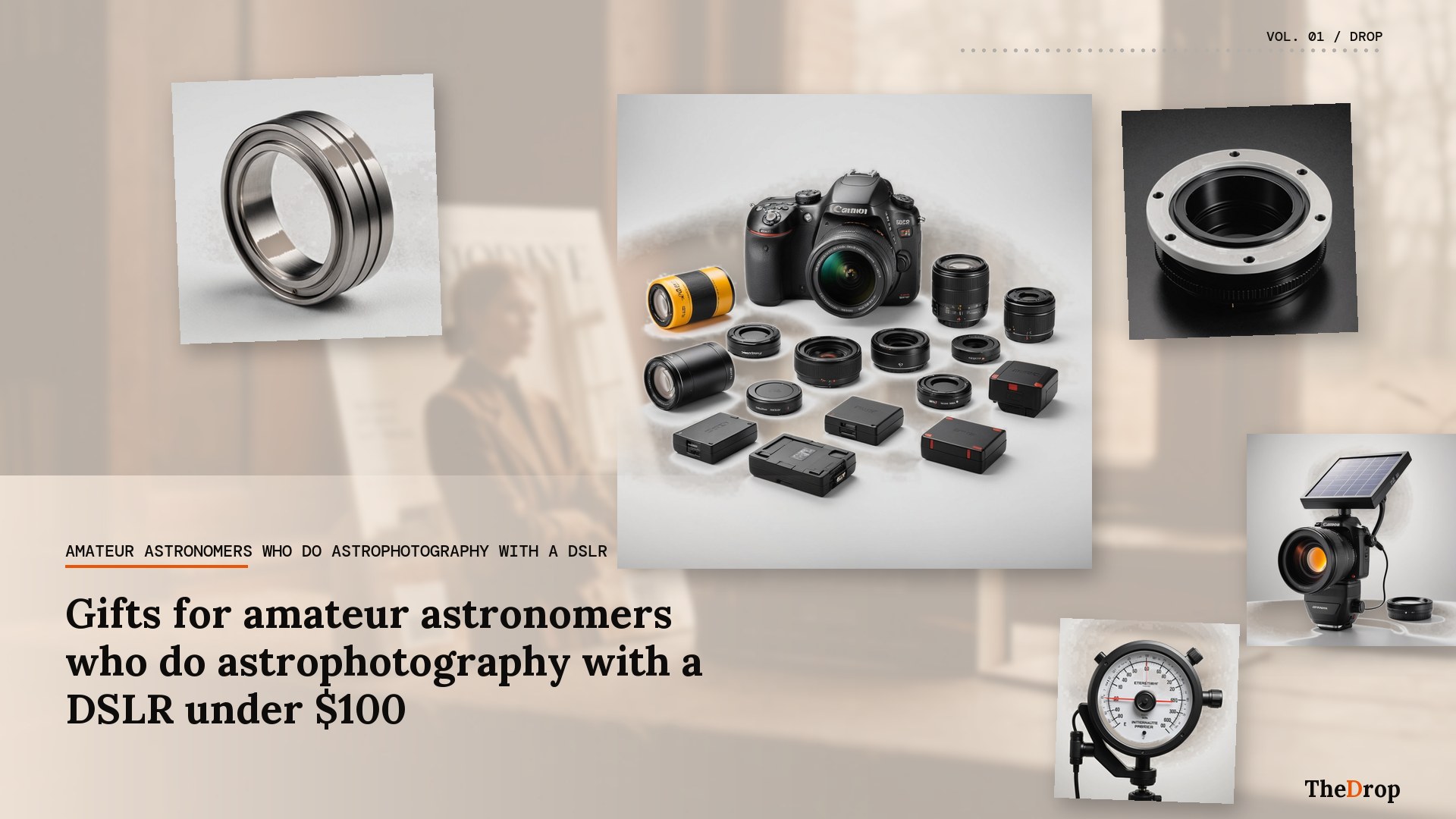
This machined ring is the physical bridge between a Canon EOS body and any telescope with a T-thread focuser — without it, prime-focus astrophotography simply doesn't happen. Costs less than twenty dollars, takes thirty seconds to attach, and immediately opens up lunar, planetary, and deep-sky imaging through a borrowed or owned telescope. Buy it before they realize they need it.
Item 6
A step beyond the T-ring alone, this adapter connects the DSLR to a telescope eyepiece focuser for afocal shooting — useful when the recipient has a telescope but hasn't sorted a direct-mount solution yet. Works with Canon EF and Nikon F mounts, which covers most beginner setups. A practical bridge between what they have and what they want to do.
Item 7
Polar alignment is the step that determines whether a tracked exposure is sharp or soft, and doing it by eye in the dark is genuinely difficult. This illuminated reticle scope makes it accurate and repeatable — the red light preserves night vision, and the reticle puts Polaris exactly where it needs to be. Pairs directly with Vixen Polarie mounts and is compatible with several others.
Item 8
Solar photography with an unfiltered DSLR destroys both the sensor and the eye. This OD 5.0 film from Baader is the material eclipse-chasers actually use — cut it to size, mount it over the lens or telescope objective, and it's safe for direct solar imaging. Sunspot season and eclipse events are the two moments this becomes urgently necessary, and it's better to have it already.
Item 9
A fingerprint on the front element at night is invisible until the next morning, and dew residue leaves the same kind of haze. This two-sided pen — soft brush first, carbon-compound tip second — removes both without touching the coatings with anything abrasive. Small enough to live in a jacket pocket, which is where it belongs every session.
Item 10
Written for people who already own the DSLR and want to understand why their images look the way they do — dark frames, stacking, polar alignment, exposure strategy. Not a coffee-table astronomy book. An O'Reilly-style practical guide that treats astrophotography as a technical skill worth learning properly rather than a filter to apply.
Fork it. Make it yours. Share before their birthday.
Friends claim items. No duplicates. No awkward conversations.