Drives Two Hours for Dark Sky. Shoots Until 3am. Does It Again.
Widefield astrophotography is its own culture — not the telescope-and-eyepiece astronomy of retirement magazines, but a camera on a star tracker, a car full of gear, and a Bortle 4 site two hours away that goes in the calendar months in advance. The person doing this has the Milky Way core schedule memorized, three dark sky sites saved in multiple apps, and a post-shoot routine that involves a 10-hour stacking session before bed. Gift editorial folds everyone into 'astronomy gift' territory and misses this persona entirely. These picks don't.
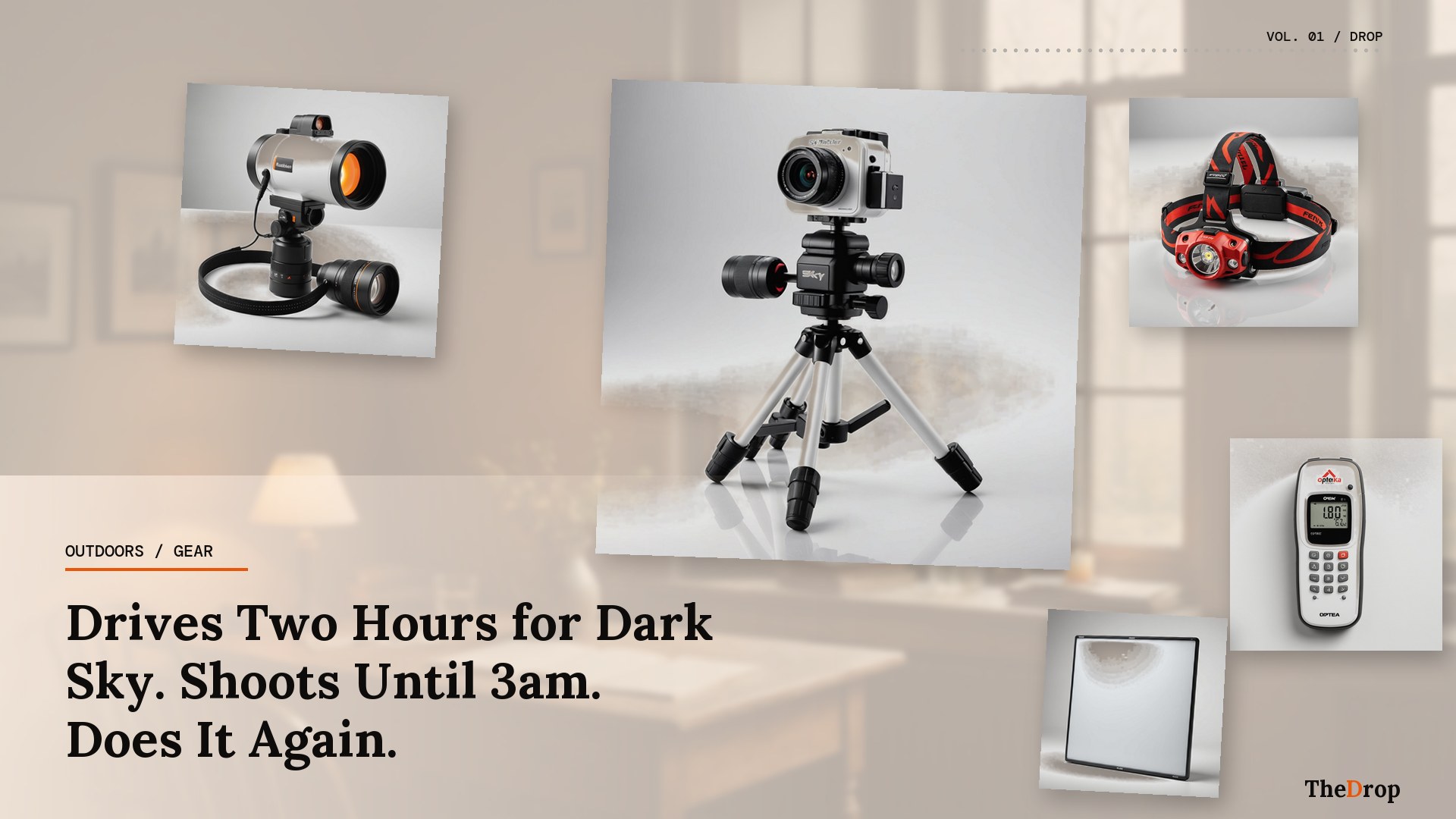
Sky-Watcher Star Adventurer Mini — Compact Camera Mount
The pocket-sized star tracker that polar aligns in minutes and enables 2-minute unguided exposures at 35mm — the foundational tool for widefield Milky Way work that eliminates star trails without a full telescope mount. Not cheap. The one piece of kit that changes everything else in the bag.
“The one reliable rule of gift-giving: anything that makes them look more serious at what they love will be received with disproportionate gratitude.”
Opteka RC-3 Wireless Intervalometer Remote Shutter
Set 100 x 90-second exposures and walk away — the automation that enables deep stacking sets without standing at the camera in the dark for three hours. Manually triggering 100 frames at 2am teaches you to appreciate this immediately.
Ruibusen Dew Heater Strap — 12V Lens and Telescope Heater
Dew forms on cold glass at dark sky sites without warning and ruins the exposures you drove two hours for. A flexible heater strap wrapped around the lens barrel maintains a few degrees above dew point and keeps the glass clear through a long night. The accessory that experienced astrophotographers add after losing one session to it.
Kase Wolverine Light Pollution Filter — Clip-In for Full Frame
Cuts sodium and mercury emission wavelengths from urban and suburban skies without requiring a filter step on the lens — the gift that makes a Bortle 5 site shoot like a Bortle 3. For someone who can't always get to truly dark skies, this changes what's possible from closer sites.
Fenix HL18R-T Red Mode Headlamp — 500 Lumen with Red LED
A headlamp with a true red mode preserves night-adapted vision while checking camera settings and adjusting equipment. Green mode from cheaper headlamps destroys dark adaptation in under two seconds. The tool they currently don't have and will immediately notice the difference once they do.
Night Photography and the Art of Long Exposure — Book by Jennifer Wu
Composition for Milky Way work, exposure math, focus technique, and post-processing workflow for stacked images in one volume. The book that bridges technical and artistic — written for photographers who are serious about the results, not just the gear.
Power Station Jackery Explorer 160 — Compact 167Wh USB-C
A compact power station runs a star tracker, dew heater, and laptop through a 6-hour shoot without a car connection. The practical limitation that ends dark-site sessions early — field power — solved without carrying a car battery into a field.
Baader Planetarium Red Astronomy Flashlight — Dimmer Wheel
A purpose-built astronomy flashlight with a mechanical dimmer — the pocket tool for checking charts and adjusting equipment without the accidental white-light trigger that cheap red lights suffer from. Baader is the brand the astrophotography community uses. Small difference; matters at 2am.
Fork it. Make it yours. Share before their birthday.
Friends claim items. No duplicates. No awkward conversations.