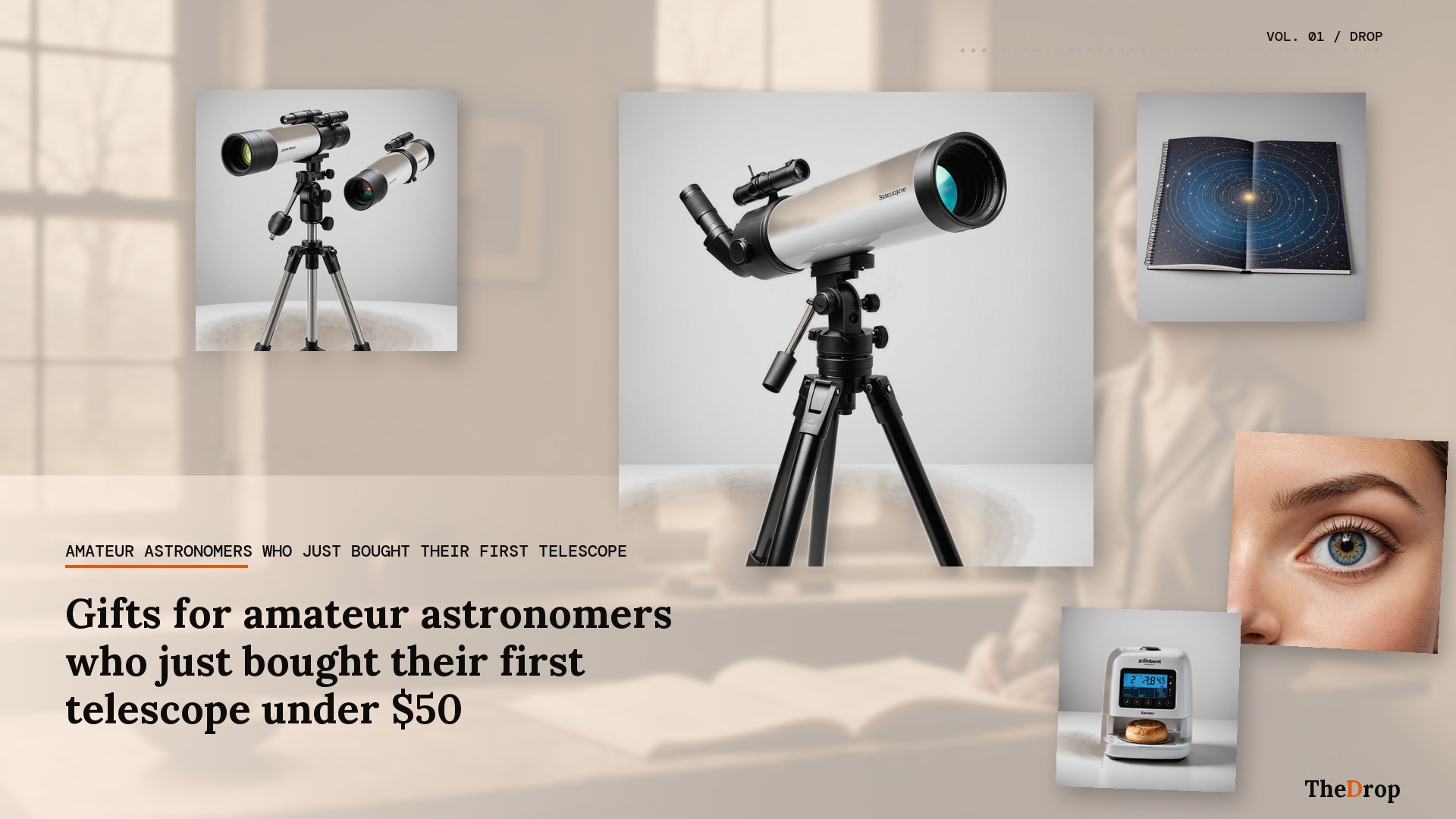
Gifts for amateur astronomers who just bought their first telescope under $50
The telescope is already unwrapped and pointed at a blurry smear that might be Saturn. What comes next — a star chart, a better eyepiece, a red flashlight that won't kill their night vision — is where the hobby either clicks or stalls. These are the things that make it click.
Item 1
The book that turns a confused first night into a structured hobby. Step-by-step star-hopping instructions guide a novice from one bright anchor star to over 100 objects visible in a small scope. Clearer than any app, more useful than the telescope's own manual, and at 4.8 stars across nearly 5,000 reviews — there's a reason everyone recommends this one first.
“The one reliable rule of gift-giving: anything that makes them look more serious at what they love will be received with disproportionate gratitude.”
Item 2
Most starter telescopes ship with two eyepieces. That's not enough. This kit adds four focal lengths plus a moon filter, letting a beginner pull back for wide star fields or push in for planetary detail — the difference between seeing a smear and seeing a ring. Fits the 1.25" focuser on virtually every entry-level scope.
Item 3
The single most common beginner complaint: the telescope magnifies, but you can't get it pointed at anything. A red-dot finderscope solves this in one evening. Mount it, align it once in daylight, and suddenly Orion's nebula is a thirty-second find instead of a twenty-minute fight. Installs without tools on most entry-level mounts.
Item 4
The Pocket Sky Atlas plots 30,000 stars and 1,500 deep-sky objects across 80 charts, spiral-bound so it lays flat on a cold car hood. The Jumbo Edition's larger type is the right call for squinting at it by red flashlight at midnight. When the beginner outgrows constellation apps — and they will — this is what they reach for next.
Item 5
Your eyes need about twenty minutes to adapt to darkness. One glance at a white phone screen resets the clock. A red LED flashlight preserves that hard-won night vision while you read a chart or adjust a focuser. Three in the pack means one stays in the astronomy bag, one goes in the car, one gets lost. At $15, the math works out.
Item 6
A rotating paper star chart calibrated to your latitude — you dial in the date and time, and it shows exactly which constellations are overhead. No battery, no signal, no glowing screen killing your night vision. Cheap enough to feel like a stocking stuffer, useful enough that experienced observers still keep one in the bag.
Item 7
The moon through a small telescope is genuinely blinding — all that reflected light, no atmosphere to soften it. A neutral-density filter screws into the eyepiece in seconds and turns an overwhelming white disk into a textured surface of craters, ridges, and shadow. Under $10, and the first time they use it, they'll understand exactly why it exists.
Item 8
Describing the moon's craters to someone who isn't there is hard. Showing them a photo is not. This adapter clamps a smartphone over a 1.25" eyepiece and turns a beginner's telescope into a passable astrophotography rig for lunar shots — no DSLR, no remote shutter, no deep knowledge required. The results are better than they have any right to be.
Item 9
Six Kellner eyepieces from 6mm to 40mm, in a padded case that actually keeps them organized. The wide end opens up large star clusters and the Milky Way; the tight end pulls in planetary detail. Orion's reputation in amateur astronomy is solid enough that this isn't a gamble. A complete set for one cent under $50.
Item 10
Projects 10,000 stars onto a ceiling and rotates to simulate the sky's nightly drift — genuinely useful for memorizing constellation patterns before standing outside in the cold trying to match a chart to the real thing. Not a substitute for the actual sky, but a decent rehearsal. Best for the astronomer who lives somewhere with real light pollution and has to plan harder.
Fork it. Make it yours. Share before their birthday.
Friends claim items. No duplicates. No awkward conversations.