Gifts for Urban Sketchers — Architecture Focus
Architecture-focused urban sketching is a discipline with its own tool logic — where the general urban sketcher might use a dip pen and loose wash, the architecture practitioner wants consistent line weights, perspective fidelity, and paper that takes ink without feathering. The Rotring Isograph is the technical pen this community uses. The perspective grid notepad is the field reference they reach for on location. These picks are for the sketcher who is serious enough to care about the right instrument for the specific job.
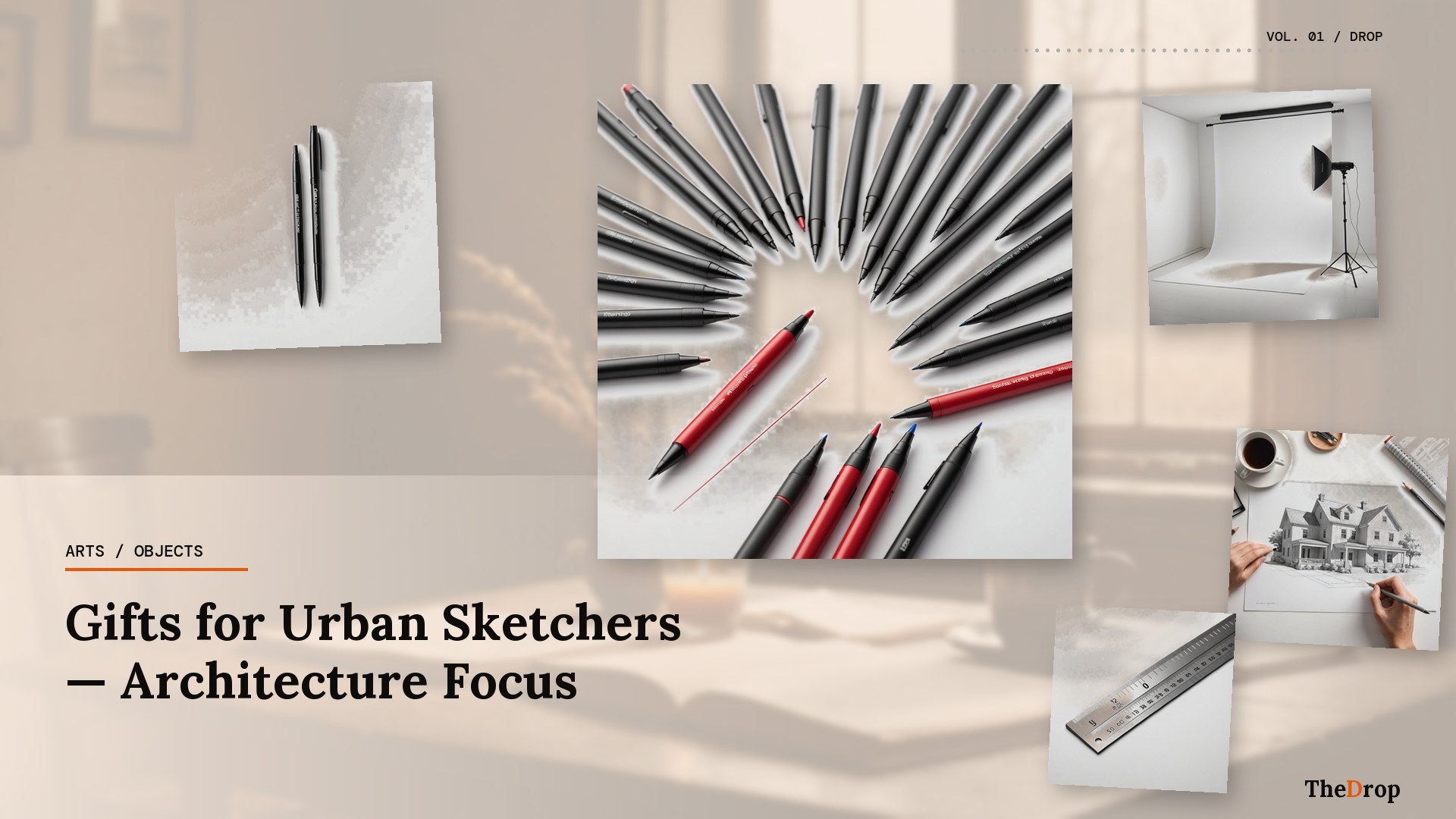
Rotring Isograph Technical Pen Set (0.2 / 0.35 / 0.5mm)
The benchmark technical pen for architectural line work. Three nib widths cover the full range from fine detail to primary structure. Refillable, precise, and built to last decades with basic maintenance.
“The one reliable rule of gift-giving: anything that makes them look more serious at what they love will be received with disproportionate gratitude.”
Leuchtturm1917 A5 Hardbound Sketchbook (Dotted, Ink-Safe Paper)
80gsm paper that handles technical pen ink without feathering. The dotted grid provides a subtle perspective reference on the page without ruling the drawing. Lay-flat binding is the critical feature for field work.
Pentel Pocket Brush Pen (with Extra Ink Cartridges)
The gestural counterpart to the technical pen. Used for loose, rapid washes of shadow and tone that give architectural drawings life. Every urban sketcher eventually carries both.
Perspective Made Easy by Ernest Norling
The foundational perspective text that architecture sketchers still recommend as a first read. Short, precise, and more useful than anything twice its length.
Clearprint 1000H Vellum Perspective Grid Pad (1-Point and 2-Point, A4)
Pre-printed 1-point and 2-point perspective grids on translucent vellum. Used as an underlay on a light pad, or worked directly for field studies. The tool that removes the hardest part of architectural composition.
Sketching for Architecture + Interior Design by Diane Fortenberry
A technique manual built specifically for architectural subject matter. Covers composition, perspective shortcuts, and the speed-drawing habits that let a practitioner capture a building in 20 minutes.
Winsor & Newton Cotman Watercolor Field Set (12-Pan)
A compact field palette for loose watercolor washes over finished ink. Many architecture sketchers use a single color — raw umber or neutral tint — to add shadow depth without complicating the line work.
Westcott 12-inch Stainless Steel Ruler (with Non-Slip Backing)
For field reference and straight-line underlay work. Non-slip cork backing means it stays put on a paper pad without a second hand holding it down.
Fork it. Make it yours. Share before their birthday.
Friends claim items. No duplicates. No awkward conversations.