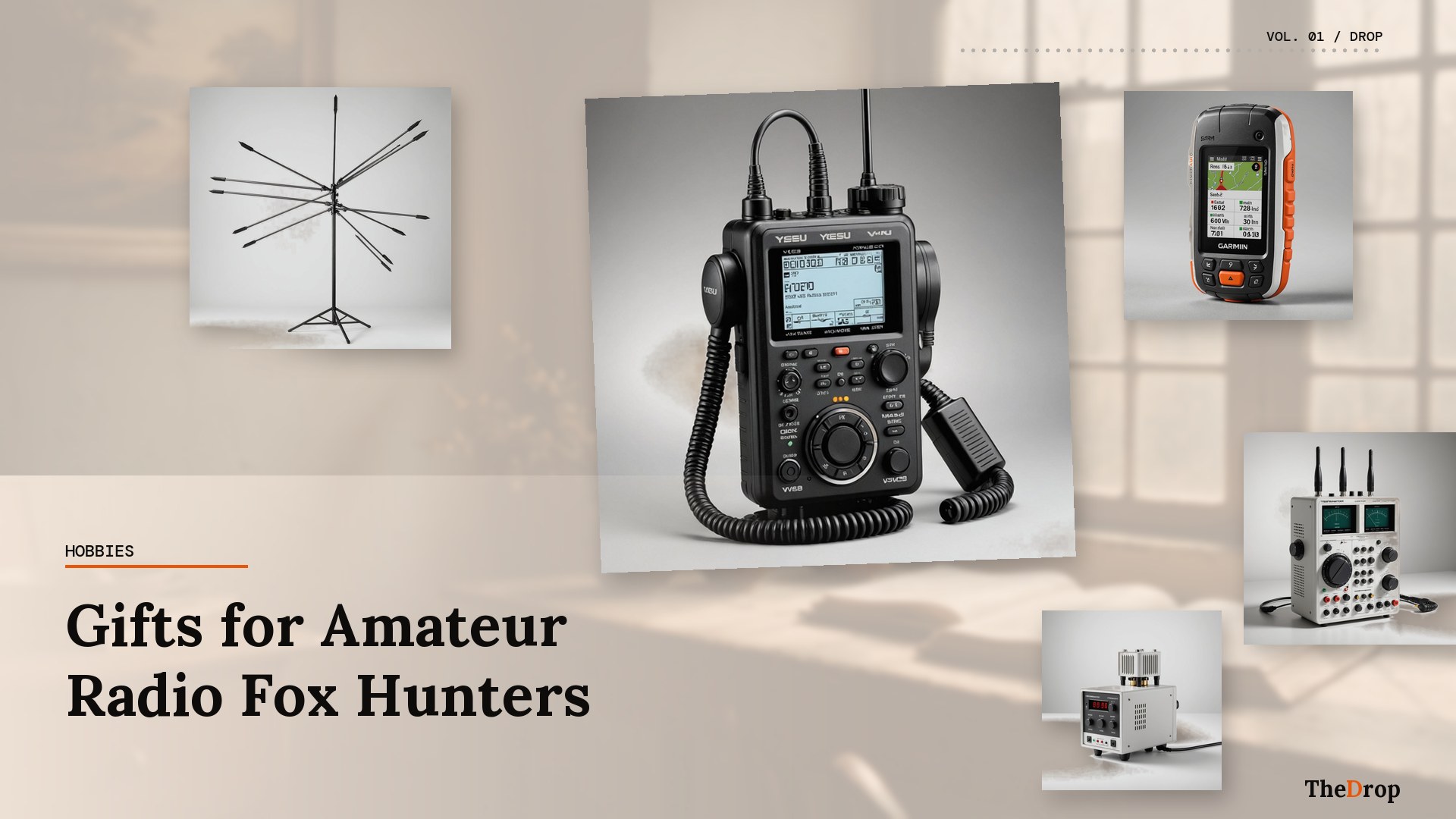
Gifts for Amateur Radio Fox Hunters
Radio fox hunters are the people who spend their weekends walking through parks with directional antennas, triangulating hidden transmitters — it is orienteering crossed with signal intelligence, and the people who do it take it very seriously.

Yaesu VX-6R Tri-Band Submersible Transceiver
The fox hunting community's preferred handheld transceiver — tri-band (2m/70cm/6m), submersible to JIS-7 standards, and with the S-meter sensitivity needed for direction finding work. The VX-6R holds a dedicated following because its receiver is quieter than most competitors in this price range, which matters when you are trying to detect a weak signal from 300 meters and your directional antenna is the only discriminator.
“The one reliable rule of gift-giving: anything that makes them look more serious at what they love will be received with disproportionate gratitude.”
Arrow Antennas 146/437-10WBP 2M/70cm Yagi
A lightweight dual-band portable Yagi that breaks down to carry in a backpack — the field-portable directional antenna that fox hunters use for the actual navigation once they are close to a transmitter. Arrow builds these for satellite work too, which means the construction quality is higher than typical fox hunting setups. The dual-band capability means it works for both 2m and 70cm fox events.
RF Power Attenuator Set (SMA, 10dB/20dB/30dB)
Fixed attenuators that screw inline between antenna and radio to deliberately reduce signal strength — essential for the final approach to a hidden transmitter, when the signal is so strong it overloads the receiver and you can no longer tell which direction is stronger. A 10/20/30 dB set covers the full range from distant triangulation to standing-next-to-it precision. Every fox hunter needs them and most beginners do not own a set.
Garmin inReach Mini 2 GPS Satellite Communicator
Satellite-based GPS with two-way messaging that works where cellphones do not — which describes many rural fox hunting venues. The inReach Mini 2 clips to a pack strap and gives position tracking, team messaging, and emergency SOS in a 3.5 oz device. Fox hunters who run events in forested or remote areas increasingly expect this as part of their kit: it is the safety layer that makes aggressive off-trail navigation acceptable.
Fox Hunting Hidden Transmitter DIY Kit (2m, QRP)
A QRP (low power) 2m fox transmitter kit for someone who wants to graduate from hunting to hiding — the other side of the sport. A well-placed fox is an art: the transmitter placement, the terrain, the interval, the power level. Building and deploying your own transmitter is the step that turns casual participants into event organizers. Most fox hunting clubs are always short of people willing to set up the fox.
"Transmitter Hunting" by Joseph Moell & Thomas Curlee (Paperback)
The definitive book on radio direction finding and fox hunting — covers antenna design, receiver modification, triangulation technique, and event organization. Written by two of the sport's most experienced practitioners, it is the reference that serious fox hunters still cite in club forums decades after publication. Out of print in hardcover but available used; finding a clean copy for a fox hunter is genuinely appreciated.
Fork it. Make it yours. Share before their birthday.
Friends claim items. No duplicates. No awkward conversations.