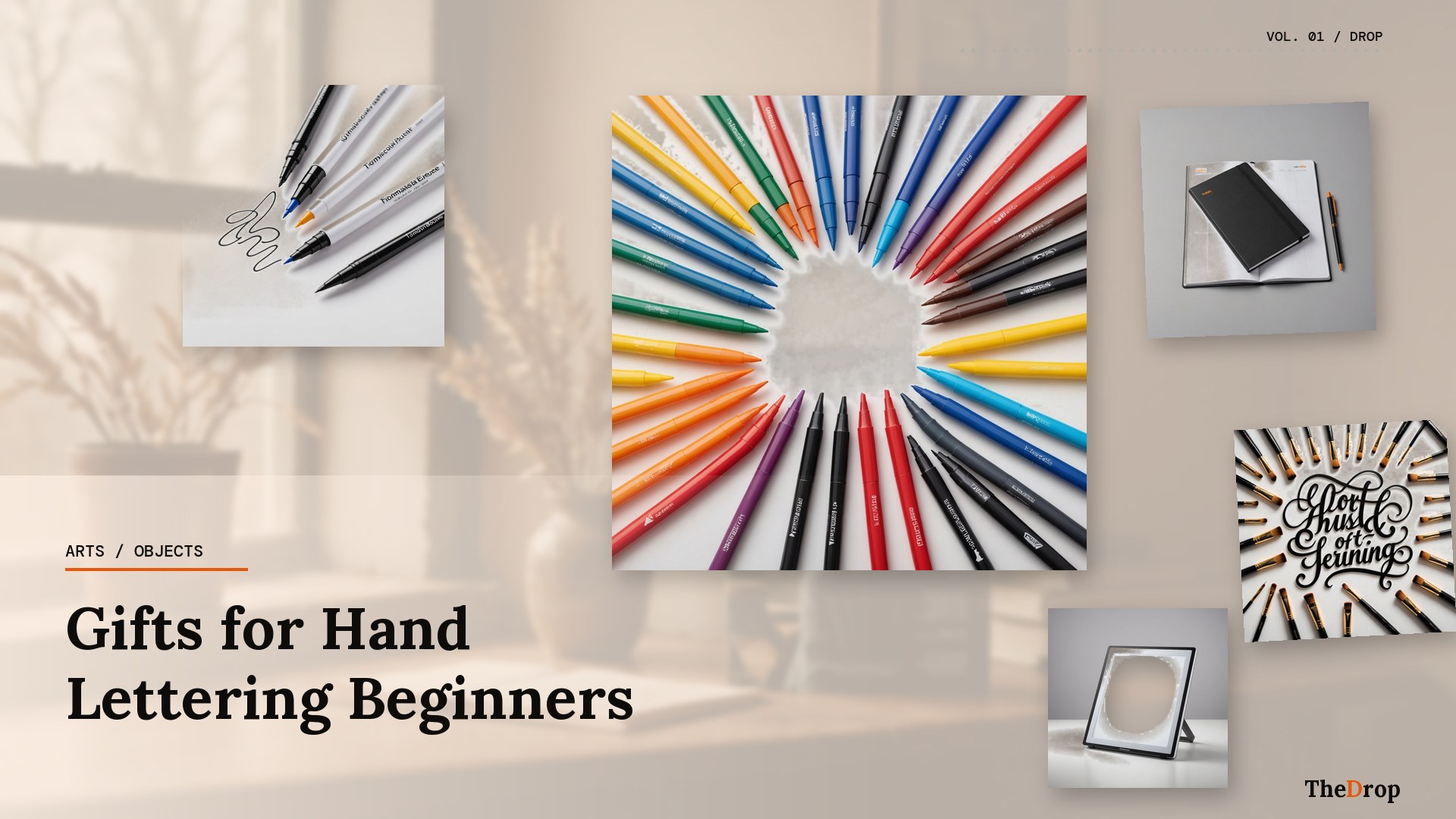
Gifts for Hand Lettering Beginners
Every hand lettering starter kit sold by a generic Amazon brand includes brushes that split on the second use and ink that feathers across the pad. The lettering community has a short, specific list of what actually works — Tombow dual brush pens, Rhodia dot-grid paper, and a workbook that teaches muscle memory through stroke drills rather than just pretty examples. These are the gifts that a beginner recognizes as right before they even open them.
Tombow ABT Dual Brush Pen Set — 10 Primary Colors
The set that every hand lettering YouTube tutorial opens with — flexible brush tip on one end, fine liner on the other, with a water-based ink that blends and layers. The gift a beginner will recognize immediately as the right tool, before they have even made a stroke.
“The one reliable rule of gift-giving: anything that makes them look more serious at what they love will be received with disproportionate gratitude.”
Rhodia Dot Grid Notepad — A5, Black Cover
Smooth French paper that allows brush pens to glide without fiber drag — the difference between a pen that forms clean strokes and one that catches and skips. The dot grid provides guide points without the visual noise of a full grid, letting the letterforms breathe on the page.
The Art of Brush Lettering by Kelly Klapstein
A workbook structured around stroke drills rather than finished alphabets — the practice approach that lettering teachers endorse because it builds muscle memory before style. Covers the pressure-release stroke that is the foundation of brush calligraphy, with pages designed for direct practice.
Artograph LightPad Light Box — A4 Slim
A light pad lets a beginner trace their best letterforms for practice repetition and transfer composition sketches onto final paper without restarting from scratch. The tool that reduces the fear of making the perfect piece — because there is always another pass possible.
Nikko G Calligraphy Nib and Pen Holder Set
The nib that calligraphy teachers recommend for copperplate and pointed pen beginners — flexible enough to show hairlines and downstrokes clearly, forgiving enough that a beginner does not break it in the first session. Paired with an oblique holder for the proper grip angle.
Higgins Eternal Black Ink — 2.5oz
The ink that pointed pen beginners use for their first copperplate drills — flows consistently through a Nikko G nib, dries quickly, and does not clog on the nib shoulder. The choice that calligraphy instructors specify in their supply lists because it behaves predictably.
Tombow Fudenosuke Brush Pen — Hard Tip, 2-Pack
A smaller, more controlled brush pen for fine lettering work and detail practice — the complement to the larger dual brush pen set. The hard tip offers more precision for beginners still developing their pressure control, making letterforms easier to control at smaller sizes.
Leuchtturm1917 Hardcover A5 Notebook — Dotted
The notebook that serious lettering practitioners keep for finished work — high-quality paper handles both brush pens and fountain pen inks without show-through, and the hardcover stays flat on a desk. The gift that tells the recipient their practice has earned a proper place to live.
Fork it. Make it yours. Share before their birthday.
Friends claim items. No duplicates. No awkward conversations.