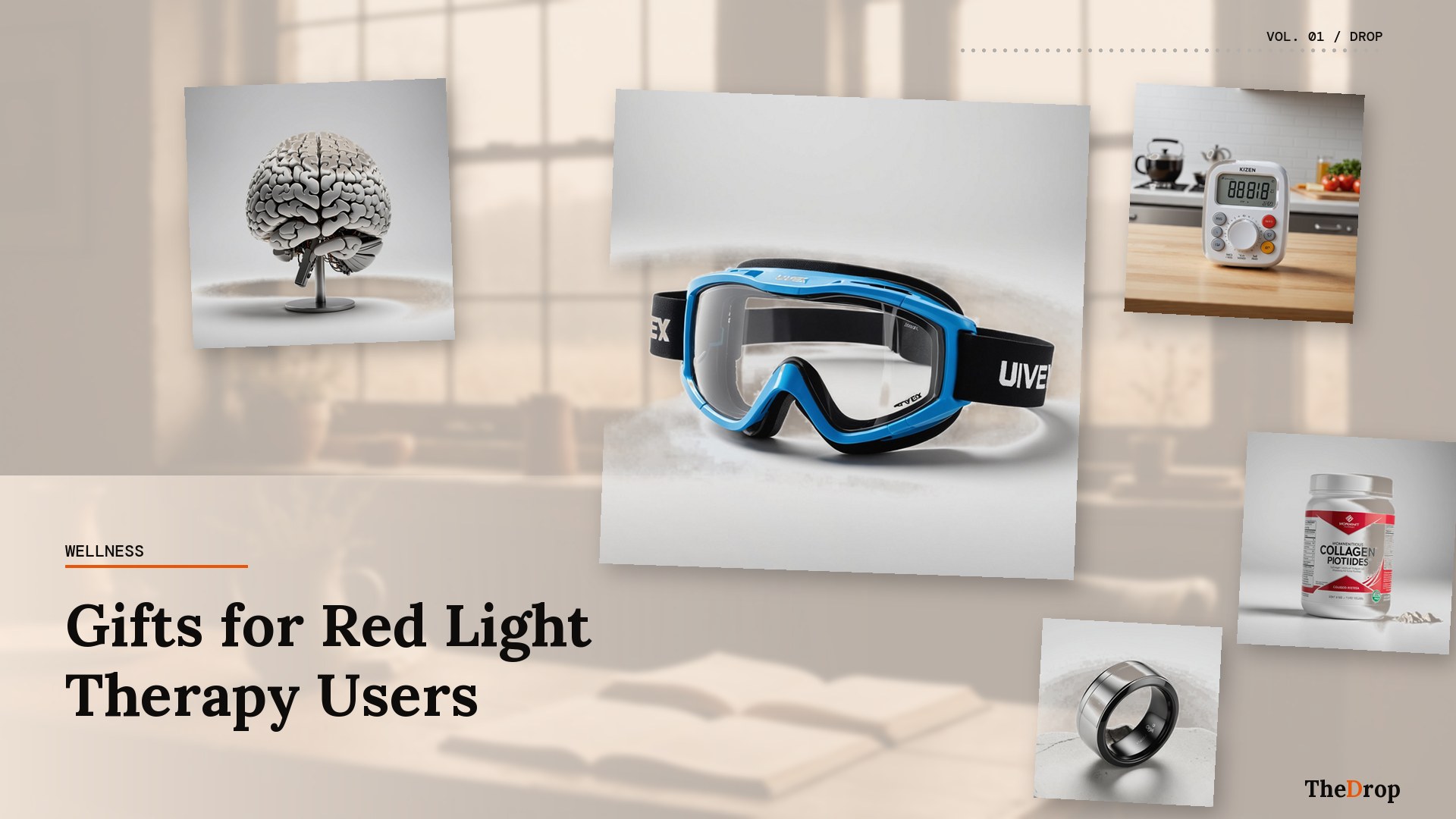
Gifts for Red Light Therapy Users
Red light therapy users have moved past skepticism into protocol. They track session times, know the difference between 630nm and 850nm wavelengths, and have an opinion on whether morning or evening exposure fits their circadian goals better. Editorial gift coverage either sells them a panel they already own or ignores them entirely. These picks are for the accessories and protocol tools that complement the panel they're already using.
Uvex Skyper Blue Light Blocking Goggles (OD 5+ Rating, Wrap-Around)
Wrap-around protective eyewear rated for direct red and near-infrared light exposure — the safety gear that most RLT panel manufacturers recommend but don't include. Eyes are more light-sensitive to NIR wavelengths than most users realize. OD 5+ rating blocks 99.999% of the relevant wavelengths. The cheap safety upgrade that practitioners describe as obvious in retrospect.
“The one reliable rule of gift-giving: anything that makes them look more serious at what they love will be received with disproportionate gratitude.”
Tao by Dr. Michael Hamblin — Photobiomodulation in the Brain
Dr. Hamblin is the most-cited researcher in the photobiomodulation field — his textbook compiles the mechanistic research that RLT practitioners reference when moving from experiential use to evidence-based protocol. Dense, technical, and authoritative. The book for the person who has been reading PubMed abstracts and wants the full picture in one place.
KIZEN Digital Kitchen Timer (Magnetic Mount, Loud Alarm, Session Tracking)
A magnetic-mount kitchen timer for tracking panel exposure time — the low-tech tool that eliminates phone dependency during sessions. Most RLT protocols specify 10-20 minute sessions at precise distances; a dedicated timer that mounts to the panel or a nearby surface means the phone stays put and session time is tracked without distraction. Simple and immediately useful.
Momentous Collagen Peptides (30 Servings, Unflavored, Post-Session)
Collagen peptides consumed within 30 minutes of a red light therapy session — the timing protocol that several photobiomodulation researchers suggest potentiates collagen synthesis. Momentous sources from grass-fed bovine and uses a hydrolyzed form for bioavailability. For the practitioner who has been reading about collagen timing and hasn't found a clean unflavored option.
RLT Session Log Journal (90-Day, Protocol Tracking, Progress Notes)
A 90-day protocol tracking journal with fields for session time, wavelength, distance, body area, and subjective outcome notes. The practitioners who consistently report results track their sessions; those who use the panel casually have a harder time attributing outcomes. A dedicated log moves RLT from hopeful practice into structured self-experiment.
Oura Ring Gen 3 (Health Tracking, Sleep + Recovery, Biometric Baseline)
The biometric ring most commonly cited by RLT practitioners for tracking sleep, HRV, and recovery outcomes across protocol changes. Above the brief's $75 ceiling but the most commonly wished-for companion device in the community. The Withings ScanWatch at $149 covers sleep and HRV tracking as a more affordable alternative.
Vital Proteins Marine Collagen Peptides (Skin + Hair Protocol, 7 oz)
Marine-sourced collagen peptides with a smaller molecular size than bovine collagen — the variant that dermatology-focused RLT users prefer for facial and skin protocol work. Vital Proteins is the brand most commonly cited in the wellness community for quality and sourcing transparency. The protocol-specific gift for someone using red light primarily for skin applications.
Rollga Pro Foam Roller (Zone-Specific, RLT Recovery Pairing)
A contoured foam roller designed to pair with RLT for recovery sessions — the physical mobility work that most practitioners add to their panel sessions after the first few months. The Rollga's zone-specific design avoids spine compression that standard smooth rollers create. For the practitioner who has been treating RLT as a stand-alone rather than as part of a recovery stack.
Fork it. Make it yours. Share before their birthday.
Friends claim items. No duplicates. No awkward conversations.